Wednesday, March 27, 2013

Family Re-Unite

Well, we've been busy the past couple of weeks with the three boys visiting Turkey.  Sam was here from March 17 until March 24, and Tyler and Mitch got to Istanbul on March 22 and will leave Ankara next Sunday, March 31.  

As Mitch and Tyler are still here, I'll only take a few minutes to post this, with more to follow after they leave.

Peggy, Sam, and I flew to Istanbul last Friday morning, and met Tyler and Mitch at the Ataturk Airport.  We already had rooms reserved and had hired a van to pick us up. (When we arrived we were told that our rooms were given to others and we were put up in a neighboring hotel a few blocks away.  Peggy's persistence got the airport transports for free for our troubles) 

So, from Friday at about 1:30 until dark on Saturday we did a lot.  So, we toured the Blue Mosque, Topkapi Palace, Basilica Cistern, The Hippodrome (chariot races) and its Obelisks (think Washington Monument), The Grand Bazaar (twice), Spice Bazaar, Galata Tower, and walked by/visited the Haghia Sophia,  Galata Bridge, Istikial Caddesi (modern shopping district), St. Anthony and St. Mary's Catholic Churches (and heard the Ava Maria sung and witnessed the last 5 minutes of a wedding!), and a Greek Orthodox Church (plus consulate/embassy from countries and lots and lots and lots of merchant shops.


Yes it rained Friday afternoon.  Outside one of the entrances to the Grand bazaar

Enjoying a "happy hour" in the shadow of the Blue Mosque

Blue Mosque Friday night

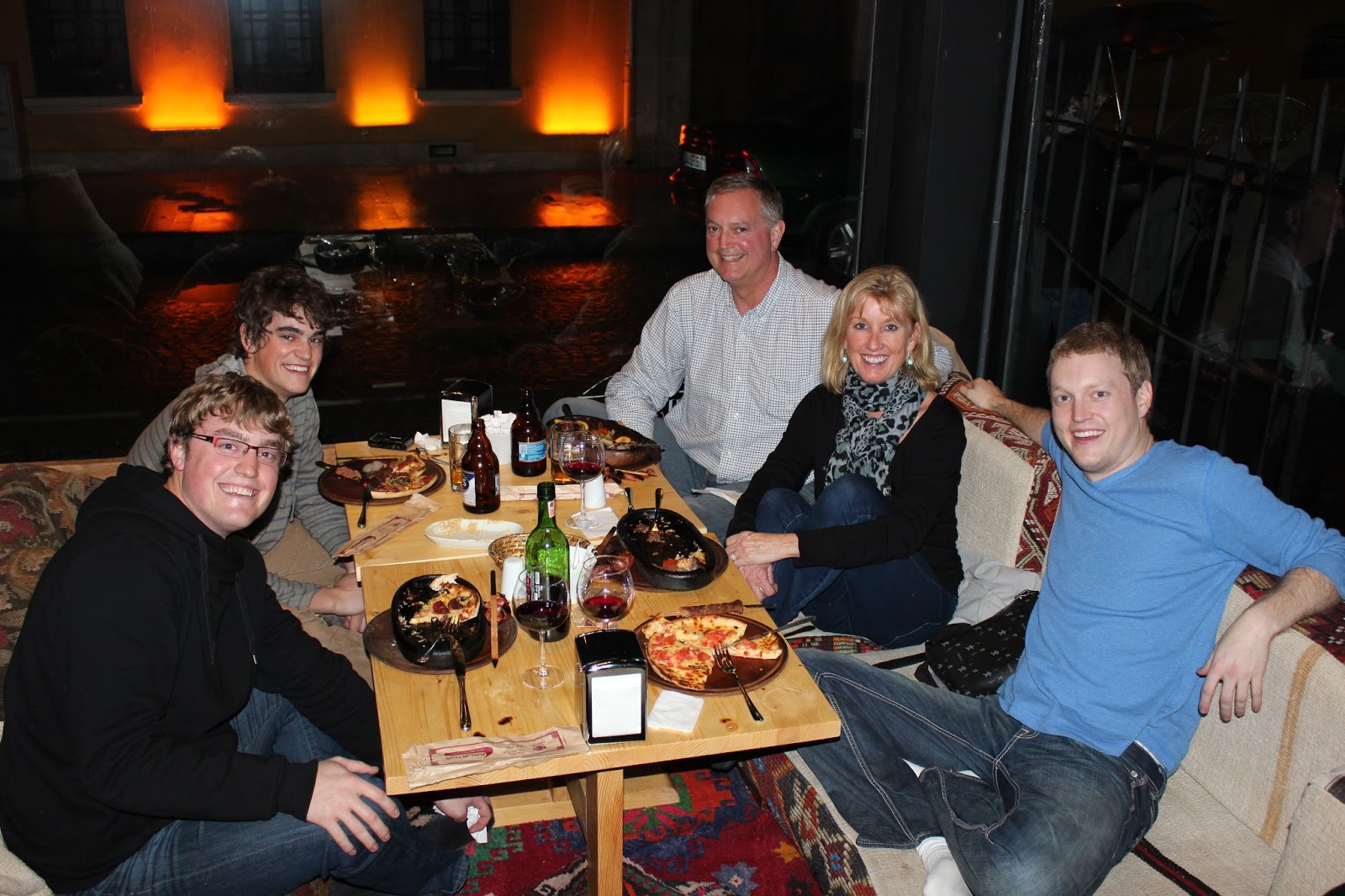
Dinner on cushions "Turkish" style

In front of the  Haghia Sophia

The Blue Mosque

Entrance to the Topkapi Palace.  Most amazing:  Moses' staff, David's sword, Joseph's turban, Mohammad's hair from his beard

From top of the Galata Tower

St. Mary's Catholic Church 

St. Anthony's with a banner of the new pope  

We estimate we walked at least 8 miles over the 2 days.  Plus we took the tram whenever we could!  We all left Istanbul at 6:00 am Sunday, with Sam starting his return trip, and the rest of us off to Ankara for the week. 


Tuesday, March 12, 2013

Kariye Muzesi-Chora Museum in Istanbul

This past weekend we flew to Istanbul on Friday evening.  We left Ankara at 5:30 and 38 minutes later landed in Istanbul.  Flying is probably cheaper than driving, as you can get one way tickets as low as 19 TL or about 10 dollars to Istanbul if you can fly during the low times.  Of course, Friday night and return on Sunday night are not low times and we paid 79 TL each way (plus 35 TL taxes and fees).  For about only $125.00 we flew round trip.  Not bad. Of course the havas-airport bus-took 1:50 to get us to the old city, which normally takes about 50 minutes, but Friday night rush hour traffic in a city of 16 million slows you down! 


Jan from Fairplay, Colorado, and Fran from Seattle, Washington, our tour guides.  Picture taken from the top of our hotel.

We went with Jan and Fran, who took us under their wings and showed us around.  Tyler, Sam, and Mitch will all be together in Istanbul.  Their overlapped time will be March 22-24, as Sam will be leaving and Tyler and Mitch just arriving for their spring breaks.  So, this trip was an opportunity for us to get acquainted with the most historic, important, and touristy parts of Istanbul's old city before the boys get here.

Chora Museum from the outside

We saw and experienced way too many items for one blog, so today I'll share with you the Kariye Muzesi, or Chora Museum.  It is located quite a ways from the notable Blue Mosque, so we taxied to this area to the west.  The full name was Church of the Holy Savior in the Country, or Church of the Holy Redeemer in the Fields.  This Byzantine era Christian church was originally built in 413 outside the city walls, or in the chora, "country."  The present structure was built in 1077-1081 and the frescoes and mosaics were added between 1315 and 1321. It's a museum now because of it's artwork.   


Frescoes painted in the side chapel walls and ceilings.  Christ being pulled both ways by God and the devil in the lower fresco.

There are six different domes within the church.  Much of the art has deteriorated and only bare walls and ceilings are left, but probably 60% remains.  What is there is remarkable.  Most of the mosaic tiles for detail on the faces are about the size of your pinky fingernail.  The larger tiles are still less than an inch in size.  

Jesus's first bath


The holy family.

The Virgin Mary's death

One of the domes.  All of the gold tiles are really gold.

This mosaic close up shows the intricate detail.  Hopefully you can see the very small tiles detailing the face and beard.  

The old marble floors were impressive as well.  You can see the main sanctuary area and ceiling have no art work visible any more in the main church. Above the door from the inside is the mosaic of Mary's death.

Of course when the Muslims conquered Constantinople, churches for Christians were often abandoned and mosques built.  In the case of the Chora church, the Muslims did not destroy it, but couldn't have their services in a place adorned with Christian symbols, as Islam does not allow iconic images. So, rather than destroy the art, they covered it with either wood, plaster,  or "white washed" over the art and used the building as a mosque for over 500 years until 1948.  A Byzantine historical organization began restoring the church from that time until 1958, when it was opened as a museum.

There you go.  We saw lots, and will see more with the boys, but I really don't think you could see every historic, artistic, or holy place if you were in Istanbul for a month.  So, we'll have to back again and again and again...   


Tuesday, March 5, 2013

Baking Cookies

Last week's news on CNN International was all about the  Mediterranean Diet.  Well, that's basically what it is here in Ankara.  We have a nice salad bar everyday at school, but no dressings.  They have lime juice, lots of olive oil, a pomegranate sauce, and vinegar for the international folks.  Most meals are vegetarian or chicken.  We have some type of meat-lamb or beef-about once every 5-7 meals and chicken maybe once a week.  So, they eat very healthy with little red meat.  

Their regular kek (unfrosted cake) and pasta (frosted cakes) are not very sweet and sometimes a little tasteless.  So, baking and making things to satisfy the sweet tooth is a must if you don't want baklava all the time.  Peggy has made crepes, and bars, and yesterday it was the first time attempting cookies.  

Ingredients are somewhat different here.  The brown sugar is exactly like our white sugar, except brown,  so a recipe that says "a cup of packed brown sugar," just doesn't know that moist brown sugar isn't available.  So, we make do.  

Karbonat is baking soda, kabartma tozu is baking powder, maya is yeast, and vanilin is--yes vanilla,but in a powdered form-think strong vanilla flavored powdered sugar!  All are about a teaspoon in measure.

We don't own a mixer, so it's a strong stir in the bowl.  We haven't found shortening, but lard is everywhere, so extra butter in this recipe.  The brown sugar just doesn't "cream" like it's supposed to.  And, chocolate chips are eluding us, so M & Ms have to do.  

We have one cookie sheet, and one broiler pan-a cooling area since there is no cooling rack.  Our timer is 2.95 TL from IKea, and the recipe book was downloaded on the IPad.


The end result was actually pretty tasty considering the swap for some ingredients and adjusting to others.  These were actually for Peggy's class and another 1st grade room, plus we're trying to butter up the housing guys who clean and manage the lojman, in case we need something, so the rest went to them.  


Wednesday, February 27, 2013

Beypazari-Old Ottoman Town

During our break, we had a day without plans so we rode along for a day trip to Beypazari 
(bay piz ara) which is about 120 kilometers northwest of Ankara.  Our high school drama teacher, Katy, has a car so we were invited to squeeze in with she and another couple, Jake and Jenny, (middle school science and high school college counselor).  We actually decided this would be a good idea on Monday night while having dinner together at a new restaurant opened by a person Katy knew. Well, in the light on Tuesday morning, it was a bit different.  

Katy owns a 1990ish Opel hatchback.  Jake and Katy have started a band, so we insisted Jake sit in the front seat so they could work on their music selections, and Peggy, Jenny, and I would squeeze into the two door's back seat. (and I mean SQUEEZE) Even with the front seats slid way forward, when the hatch was closed, I couldn't sit up, as the glass from the hatch was where the top 5 inches of my head belonged.  I sat with my head held at an angle against my shoulder, leaned forward curled against the front seat, or with my face craning up and my nose plastered against the glass of the hatch.  Of course, I took up about half of the back, so I suppose it was no easier for Peggy or Jenny! (I just walked up to Katy's logman to get a picture of the car but it's not there!) Of course we got lost, adding an additional 20 minutes onto the supposed 1:30 trip, and it took me a few minutes of stretching and walking to unkink upon arrival.


Jenny, Peggy, and I enjoying the ride

Beypazari is an old Ottoman town, that was refurbished into a tourist attraction, with many of the Ankara residents who want to get out of Dodge going there.  Right off the main highway is a new and modern park and center, with shopping and commerce on wide streets.  There is a major silver jewelry business in Beypazari, with several shops in the new part of town.  What it is really known for is it's carrots-the "best in the world," as I was told by one of the merchants, and a bottled, sparkling water "Beypazari" which I think is bottled elsewhere but uses the name.  


Gathering at the park.  We've noticed this in Ankara as well, much like the piazzas in Italy


-
Modern and old on the same streets.  Notice the sign above her head

Up the hill beyond the modern city is the old town.  It is a tourist destination, much like Ulus in Ankara.  There are many shops and small cafes, with jewelry makers and fruit shops making up many businesses.  Of course there are shops dedicated to making you fresh carrot juice.  With the old town atmosphere, one might enjoy watching an old woman tediously working the pedals of an old press, slowly squeezing and extracting the juice from a dozen carrots to get you a small bottle of the precious liquid.  Instead, Jack LaLanne would be proud, as electric juice machines are set up and roaring in front of the shops on the street, and just 5 big carrots are mashed, crushed, chopped,and pulped into juice in a matter of seconds.  Only Katy, a vegetarian,  was interested, but after sampling the juice, we all bought bottles as it was truly great, for I think 5 TL.

Making juice for Katy

A young merchant telling of the fertile farmland of Beypazari and why it grows the "best" carrots

Now I have to admit, we've bought carrots here in Ankara, and they really do taste much sweeter than those we are accustomed to eating in the US.  The carrots aren't harvested all at once.  They are left in the ground, and hopefully a small snowfall will insulate them and keep them fresh, but not frozen in the ground "for up to 6 months," I was told.  Every day some are taken from the fields.  We passed a load tied up in giant plastic sacks heading to Ankara on our way home.  So, I'm on the band wagon now.  Come and try the world's best carrots.  

We wondered around town and went into a restaurant, which was really upstairs above the bakery/kitchen.  We had some great food.  Most restaurants start out with lots of bread and different dipping/spreads, and their bread was fantastic.  You just grab hold a a loaf and rip off chunks!  Jenny had the best meal, as it was served in a small ceramic pot, with a kind of stew bubbling in the scorching hot pot.  They had a variation of traditional baklava, with layers rolled instead of stacked, which we actually liked better because it wasn't quite as sweet.  

Lunch with Jenny, Jake, and Katy
They must package this and sell it elsewhere.  I don't think they served enough people upstairs in the restaurant to eat it all!

After lunch we walked around town some more.  We hiked to the top of town and Peggy, Katy and Jake climbed up some rocks to see the view of town on the other side.  They saw more rocks-just like hiking in Colorado-what you think you'll see over the horizon as a pleasant valley is usually another incline.  So, we wondered back down, bought some jewelry, and broke down and bought some baklava to take back home with us-about $2.00 for four pieces!

This is a different shop with traditional baklava

I'm pretty sure this is the first time I've seen a carrot statue in the middle of any town, any where.  Mitchell South Dakota's Corn Palace has nothing on Beypazari!!   (I didn't find out if their high school mascot is the Carrot Diggers)  Peggy's saluting with our bottle of carrot juice.   

We headed back, with Peggy and I in the front passenger seat this time.  She had about 3 inches of seat between my legs (roof too low for her to sit on my lap) and we motored back to Ankara without getting lost this time.  


Sunday, February 17, 2013

Cappadocia

Our winter break has come to a close.  We returned last night from Goreme, a small town in the mist of Cappadocia.  We left by bus from the Asti Station here in Ankara.  The bus trip cost 35 TL one way, and took about 4 hours to get to Nevsehir and than another 15 minutes in a smaller bus to Goreme. 

The bus left Asti at 11:00 and immediately after pulling out of the station, an attendant, much like a flight attendant, gave us all a splash of hand sanitizer.  Then he wandered down the isle with a large bottle of water, and poured glasses for those interested.  About 15 minutes later he handed out small packaged cakes, followed by cay or coffee, then Pepsi or Fanta orange.  In the seat backs were monitors showing the cartoon network, two US movies, and a hand full of Turkish programs-all in Turkish!  There was an MTV Turkish music station to listen to.  

One channel was a camera above the driver's head showing to road since the seat back were too high to see over!
Our attendant sitting and visiting with the driver

About half way we stopped for a bathroom break in Serefli Kochiser, next to their giant Salt Lake.  After the break, more hand sanitizer, water, cay/coffee, and soda.  

We arrived in Goreme at about 3:30.  Our school does a trip for new folks every fall to Cappadocia and stay in Goreme at, and I kid you not, the Flintstone Hotel.  So, that's where we stayed, but no sign of Fred, Barnie, Thelma or Pebbles.  There were however three different workers named Memhet!

Notice the carved out and uneven ceiling.  Three walls were the same.  There was a big Jacuzzi tub and nice shower in the bathroom, but the entire place was dark!  The lights were about 7 watts each.

After unpacking we walked about 4 blocks to the shop and cafe area of town.  We wandered around town, took pictures, played scrabble (Peggy won) in a bar and had local Cappadocian wine, and eventually ended at Dibeck  Inn and had an incredible meal.  

We sat on cushions on the floor and the owner served our meal.  Peggy's came in this sealed clay pot which he had to tap with a hammer to open.  This was probably the best meal we had since getting here.  

When we arrived we booked a tour with one of the Memhets, for Friday.  A small bus picked us up at 9:30, after another Memhet cooked us fried eggs and French toast at the hotel's restaurant.  We first stopped at an overlook seeing the Pigeon Valley.  The rain that had started at about 8:00, was now sleety snow and wind.  As we traveled up in elevation, the snow ended up about 6 inches deep, and very wet and slushy.  Take heart, this in no way changed how the driver attacked the curves and valleys.  He even passed a small car on a hill, forcing it to pull off as a bus was coming and we had to cut off the car to get back in our lane. In our tour group there were a couple of Korean ladies, an Indonesian couple, a girl from Malaysia, and a couple from Brazil.  Our guide did a good job of talking about Christianity and his religion, as a Muslim.  "Being a Muslim, it is a sin even to kill an animal, so real Muslims don't kill other people."  We liked him.

Our tour guide, Onu (Jonah)

We first stopped in Derinkuyu and its underground city.  The Christians, who once inhabited this land, were not very well accepted by the various conquering factions, so they often had to hide in underground cities and caves to survive. We were told that the caves had pretty low ceilings and tight spaces.  I started down the first set of steps and decided that 30 minutes in a crouched, tight position was not for me, so Peggy went on alone. In the caves they had meeting rooms, a water well, school areas, as well as sleeping quarters, and even a place for their animals.  Peggy counted 105 steps below the surface, so it's down there.  They had fresh air tunneled in and "doors" where they could defend themselves from enemies it they ventured down to encounter the locals.  


They could shoot arrows or poke spears through the "door's" peep hole

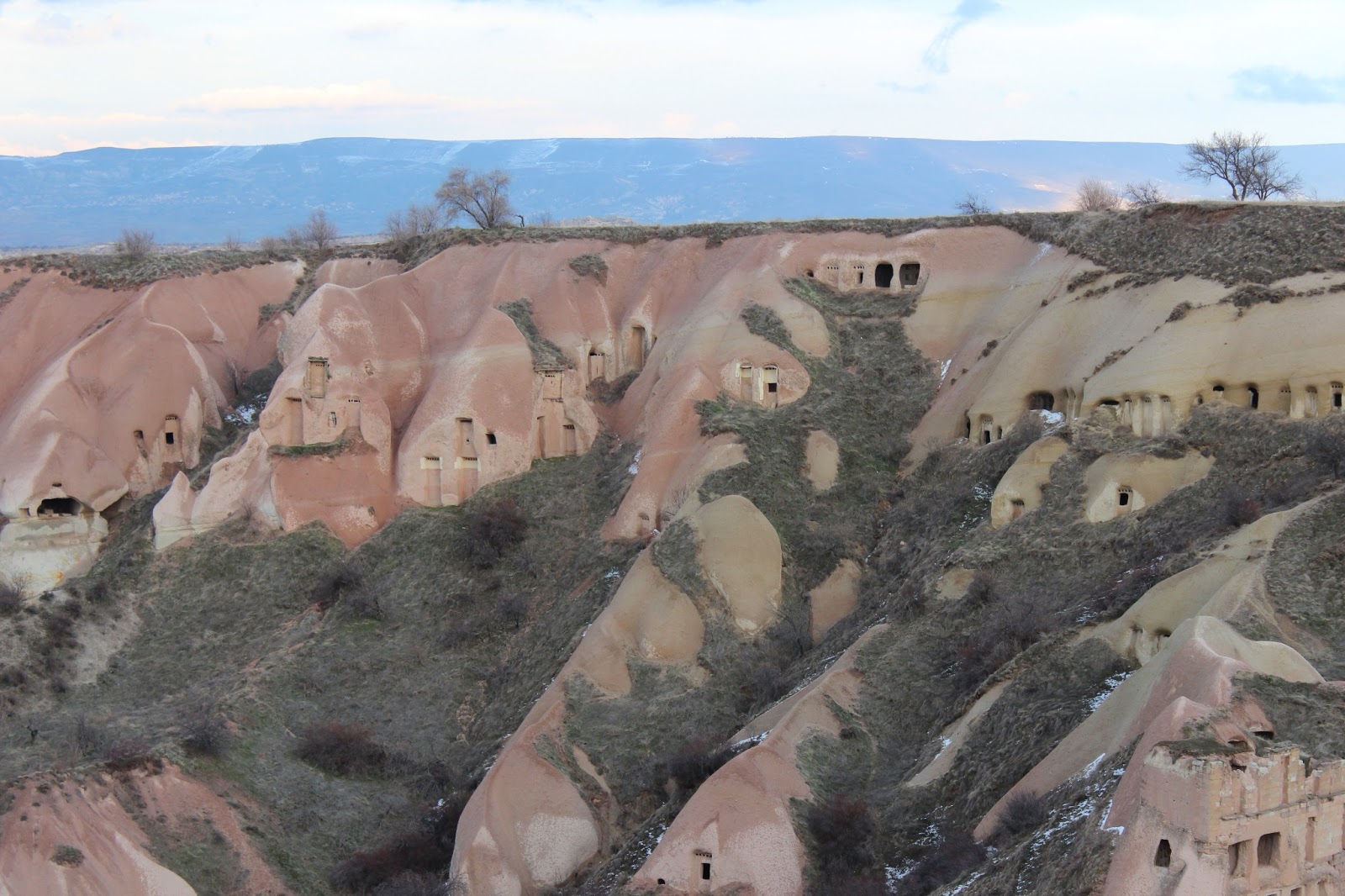
Thankfully the snow stopped and it melted quickly.  We then were taken to the Ihlara Valley where we walked along the Melendiz River for about 3 kilometers and saw hundreds of cave dwellings.  Throughout the entire 14 kilometer valley they estimate there were about 4000 dwellings and 8000 residents, along with over 100 churches.   All caves had small roosting caves/holes for the local pigeons right next to the people caves.  The pigeons provided droppings for fertilizer for crops, the eggs were eaten and used for sealing frescoes in churches, and they killed them for their meat.  
Notice the smaller dots or pigeon roosts 

There were numerous cave churches along our short route, and we visited St. Daniel's Church or Church under the Tree. It was a small cave with two small side areas and the main celebrating area and alter.  Maybe 75 people could crowd in at a time, more if all stood.   At the entrance was an interior dome with the ascension painted on it. These being at least a 1000+ years old, it is remarkable that the color and quality is still clearly visible.   

The fresco on the ceiling shows Christ's ascension into heaven, assisted by angels.  

We had lunch along the river and then continued to the Selime Cathedral (Selime Katedrali) which was once a monastery and built into numerous "fairy dome" rock formations.  In the various caves there were cooking areas, a school room, gathering spaces, sleeping areas, prayer rooms, and of course, the main cathedral.  They believe the frescoes in the cathedral go back to the 8th century.  Wow, and we think buildings in Salida built in 1885 are old! 


The school room, with individual bedrooms above


More frescoes in the cave cathedral.  The amount of rock that had to be moved to create these large spaces is amazing, given the very basic tools available.  

Pigeon Canyon

After the Cathedral, we traveled back to Pigeon Canyon, now without the snow, and stopped at at a jewelry shop before making it back to Goreme.  Dinner this night was again excellent, with a wonderful red pepper paste made with olive oil, peppers, and walnuts as an appetizer. Beef for me and chicken for Peggy at the Seten restaurant.  We stopped at a small place for baklava  and pistachio ice cream and listened to a Turkish singer before heading back to the cave.  

A lit cone in the foreground, where Christians dug caves and  lived, and the minaret at a mosque in the background in Goreme. 

We did a couple more day trips this past week that I'll post later.  Back to work tomorrow!